Unit conversion: factors, offsets and useful precision
Updated October 12, 2026 · Reading time: 6 min · 6 sections
7.5 square feet is 0.6967728 square metres. Getting that unit conversion right means squaring the foot factor; temperature needs a different method because its zero point moves too.
Choose the quantity before the factor
The general converter separates twelve quantities: length, mass, temperature, area, volume, time, speed, digital storage, energy, pressure, angle and frequency. Select “All 12 categories”, choose one, and then set the source and destination units. An answer in metres cannot become an answer in square metres merely by changing a label. Length describes a line; area describes a surface. The category is part of the calculation, not just a way to shorten the unit menu.
I also distinguish mass from volume before converting kitchen quantities. A gram measures mass, while a millilitre measures volume. General volume conversions do not need an ingredient. Crossing from cups to grams does, so use the ingredient converter for that task. The cups-to-grams guide explains why a flour reference and a honey reference lead to different masses even when the selected cup is identical.
A unit conversion through a common base
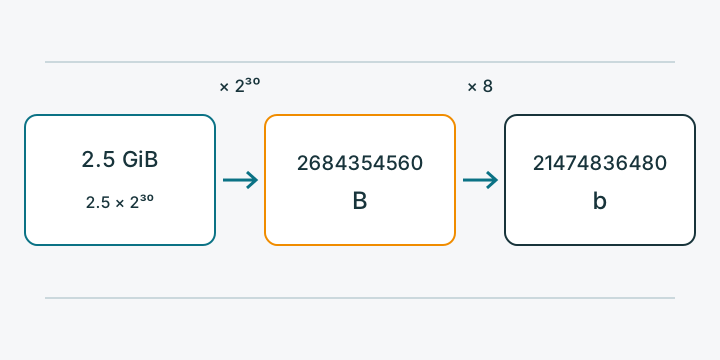
For multiplicative units, the relationship is output = input × source factor ÷ destination factor. Each factor expresses one unit in the category's common base. The illustration below follows a quantity through its source value, base-unit equivalent and destination value. In the live converter, the paired scales compare the source and destination directly. Read the unit symbol beside each value. In digital storage the base is a byte, written B, while a bit is written b. Those symbols describe quantities that differ by a factor of eight.
Take 7.5 square feet. One foot is 0.3048 m, so one square foot is 0.3048 × 0.3048 = 0.09290304 m². Multiplying 7.5 × 0.09290304 gives 0.6967728 m². Using the linear factor just once would produce the wrong area. The same reasoning applies to a cubic length measure: all three dimensions contribute to the volume factor. I keep the exponent visible when checking or copying the answer.
| Input and destination | Calculation | Unrounded or approximate result |
|---|---|---|
| 7.5 ft² to m² | 7.5 × 0.3048² | 0.6967728 m² |
| 451 °F to °C | (451 − 32) × 5/9 | 232.777777… °C |
| 2.5 GiB to bits | 2.5 × 1073741824 × 8 | 21474836480 b |
| 12.75 psi to kPa | 12.75 × 6.894757293168361 | 87.9081554879… kPa |
The NIST conversion-factor tables distinguish unit definitions and conventions. Here the psi factor uses the international pound, standard gravity and the international inch. I use that factor to convert the pressure reading, then check the equipment’s own specified limits separately.
Temperature changes both scale and zero
The familiar Fahrenheit formula is F = C × 9/5 + 32. In the reverse direction, C = (F − 32) × 5/9. For 451 °F, subtract 32 to obtain 419, then multiply by 5/9 to obtain about 232.777778 °C. Multiplying 451 by 5/9 without the subtraction would not describe the same temperature. The converter handles this offset separately from the factor-only categories.
Kelvin is an absolute scale: K = C + 273.15. A Celsius value of −273.15 therefore corresponds to 0 K, while −273.16 °C falls below that boundary and is rejected. Negative Celsius or Fahrenheit values are otherwise allowed. The NIST temperature reference explains these scale relationships. The converter converts temperature readings, rather than temperature differences; a difference of 10 °C corresponds to a difference of 18 °F, not a reading of 50 °F.
An oven example needs another distinction. A numerical conversion such as 180 × 9/5 + 32 = 356 °F gives a scale equivalent. It does not mean that an oven dial has that exact setting or that the fan setting, pan and baking method can be inferred from the formula. I keep those practical decisions with the recipe. The cup and spoon systems guide follows the same habit for ingredient measures.
MB and MiB answer different questions
The decimal megabyte is 1000000 bytes. The binary mebibyte is 1048576 bytes. Thus 1 MB is 1000000 ÷ 1048576 = 0.95367431640625 MiB. Neither label is a rounding choice for the other. Select the unit that the original specification actually uses. For 2.5 GiB, the binary factor is 1073741824 bytes per GiB; multiplying by 2.5 gives 2684354560 B, then multiplying by eight gives 21474836480 bits.
The NIST binary-prefix reference names the powers of two that distinguish KiB, MiB and GiB from decimal units. Storage capacity does not by itself establish download duration. A transfer rate would need its own time unit and assumptions about the connection. This converter converts storage quantities; it does not measure your network or contact a remote conversion service.
Choose digits after checking the definition
Open Rounding options for significant figures or decimal places. Significant figures count meaningful digits across the value, while decimal places count positions after the decimal separator. For 12.75 psi, six significant figures show approximately 87.9082 kPa; two decimal places show 87.91 kPa. Both displays come from the same underlying calculation. Extra displayed digits do not improve the accuracy of the original pressure measurement.
Very small nonzero values use scientific notation when decimal rounding would conceal them as zero. Very large finite values also use a compact scientific display. Arithmetic still uses browser floating-point numbers, so it has a finite range and precision. An unrepresentable result is shown as unavailable rather than advertised as a valid zero. In the all-unit table, an unavailable equivalent cannot be copied. A same-unit conversion retains the entered finite quantity.
Check the conventions that are not universal
The average year option is 365.2425 days and the average month is one twelfth of that duration. Neither option counts the days between dates or identifies the duration of a particular calendar month. The Mach option assumes a sound speed of 343 m/s. Actual sound speed depends on conditions, so entering one Mach here expresses that stated assumption rather than measuring an aircraft's speed.
- Identify the quantity and the complete source symbol.
- Select the destination and inspect any convention note below the result.
- Check a familiar equivalent in the all-unit table before copying.
- Choose suitable display precision, then copy the value with its unit.
The amount field accepts a decimal point or comma, simple fractions, mixed fractions and scientific notation. Write 1500 without a thousands separator. A suffix such as 12cm is invalid: type 12 as the amount and select centimetres separately. Swapping transfers the unrounded result to the new amount field and reverses the units. Reset restores the starting length conversion and clears the filter. Return to the unit converter to try the examples with your own quantities.
Things people ask
Can I convert a temperature difference?
The temperature workspace converts readings. Temperature differences do not use the same zero-point offset: a difference of 10 °C equals a difference of 18 °F.
Why does the digital diagram use B?
B is the byte symbol, the common base in this category. A lowercase b means a bit; there are eight bits in a byte.
Does choosing more digits make the measurement better?
No. Display precision controls rounding only. Original measurement uncertainty and any approximate unit factors still apply.
What does an unavailable equivalent mean?
Its value is outside the supported numeric range. The tool shows an unavailable value and disables that row’s copy button instead of silently returning zero.