Cups to grams: choose the ingredient before the number
Updated October 12, 2026 · Reading time: 6 min · 7 sections
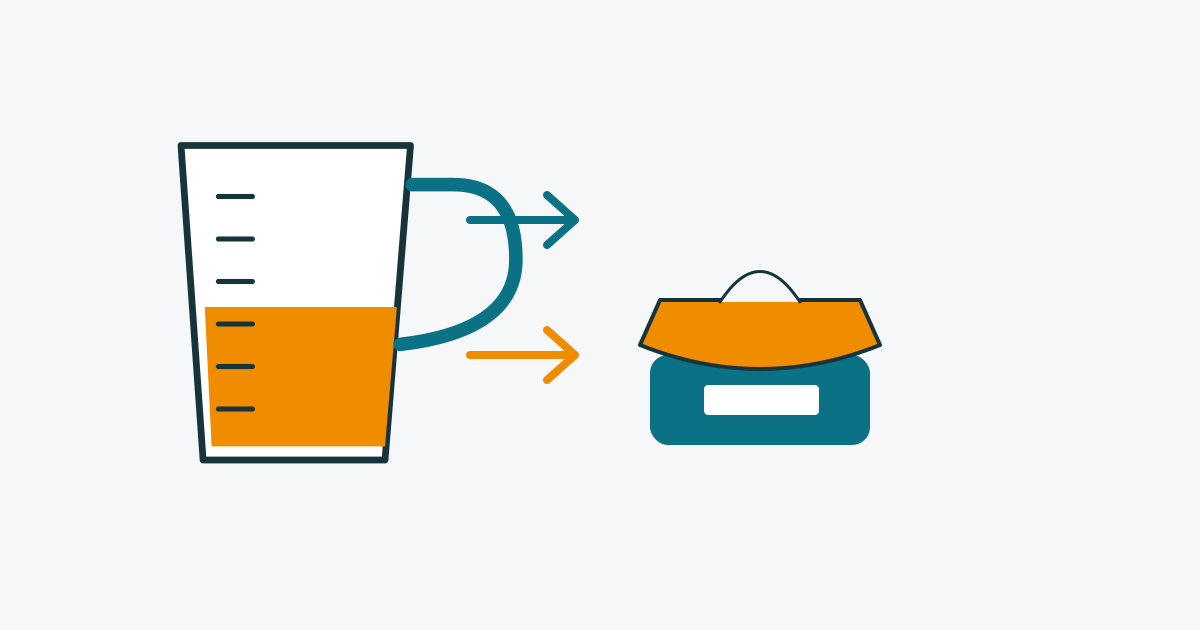
One US cup of flour is estimated at 120 g; the same cup of sugar is 198 g. For cups to grams, I choose the ingredient before entering the amount.
The first choice is the food
Before typing a quantity, identify the ingredient as precisely as the recipe does. All-purpose flour is not almond flour, and packed brown sugar is not loosely poured granulated sugar. Even a familiar name can hide a preparation instruction. Powdered sugar may be sifted or unsifted; oats may be rolled, quick-cooking or steel-cut. A volume-to-mass estimate needs the matching reference, otherwise a carefully computed number answers the wrong question.
The ingredient converter includes a compact group of baking staples rather than hundreds of vaguely described foods. That makes the preparation visible. The rolled oats entry follows King Arthur's own product, at 113 g per US cup. The chart lists 89 g per cup for old-fashioned or quick-cooking oats, so the named product should not stand in for every oat type. If your ingredient is missing, I would weigh it rather than choose a different food because it looks similar. The quantity being converted is the amount of that ingredient, not the size of the package it came in.
Read the serving size, not just the grams
The King Arthur Baking chart gives masses alongside reference servings. Some servings are a cup; others are a tablespoon or part of a cup. Flour uses 120 g per cup. Honey is listed at 21 g per tablespoon, so the derived cup estimate is 16 × 21 = 336 g. Butter is 113 g per eight tablespoons, giving 113 ÷ 8 = 14.125 g per US tablespoon. These are chart estimates, not exact density measurements.
| Ingredient | Original chart serving | Derived grams per US cup |
|---|---|---|
| All-purpose flour | 120 g per cup | 120 |
| Granulated sugar | 198 g per cup | 198 |
| Packed brown sugar | 213 g per cup | 213 |
| Butter | 113 g per 8 tablespoons | 226 |
| Honey | 21 g per tablespoon | 336 |
| Unsweetened cocoa | 42 g per half cup | 84 |
The word “derived” matters. It means the table retains the original chart relationship instead of pretending every row was weighed as a whole cup. Butter's chart estimate for half a cup is also distinct from a US butter stick defined as a quarter-pound mass. The stick option uses 453.59237 ÷ 4 = 113.3980925 g. A rounded chart serving of 113 g and that mass definition can both be useful, but they should not be silently treated as identical.
Follow one calculation from cup to scale
Take one and a half US cups of granulated sugar. The chart estimate is 198 g per cup, so the calculation is 1.5 × 198 = 297 g. You can enter 1 1/2 directly in the amount field. For a quarter of a cup, the same reference gives 0.25 × 198 = 49.5 g. The tool displays the ingredient, source unit and result together so the copied answer does not become an unexplained mass.
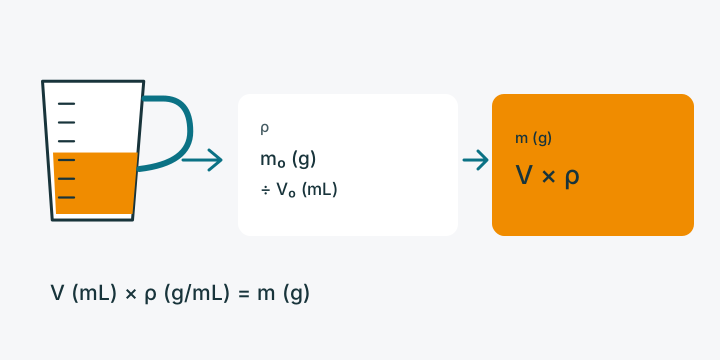
For millilitres or a metric cup, the calculation needs the ingredient’s estimated density. Flour's reference density is 120 ÷ 236.5882365 ≈ 0.5072103405 g/mL. One 250 mL metric cup therefore gives 250 × 0.5072103405 ≈ 126.8025851 g. That differs from a US cup's 120 g estimate because the selected volume is larger. It does not mean the flour became denser when the unit changed.
The arithmetic cannot level a cup for you
A volume measure includes the spaces between particles. Flour settles and compresses, so the way you fill a cup changes its mass. I follow the recipe's measuring method when it provides one, and use a scale when it provides grams. Brown sugar's packed entry explicitly assumes a preparation state. A density estimate cannot infer whether your cup was loosely filled, shaken down or firmly compressed.
Moisture, brands and the size of pieces affect how much an ingredient weighs. I use the chart for planning, then round to the precision of my kitchen scale. Extra displayed digits help check the calculation; they do not make the cup measurement more accurate.
Convert the ingredient list before scaling
- Read the recipe's own gram weights and measurement notes first.
- Choose the matching ingredient and the source cup or spoon definition for each row.
- Enter the quantity, including fractions where needed, and inspect the grams output.
- Apply one recipe multiplier after every row has a valid amount.
- Export the worksheet with its reference weights or print a copy for the kitchen.
Consider a hypothetical list with 1 US cup flour, 1/2 US cup granulated sugar and 2 US tablespoons honey. The starting estimates are 120 g, 99 g and 42 g. A multiplier of 1.5 gives 180 g, 148.5 g and 63 g. Each line uses its own ingredient reference. The multiplier does not pool the volumes or apply flour's density to the sugar and honey. Keeping the rows separate also makes an accidental teaspoon-versus-tablespoon choice easier to notice.
A filled row with an invalid amount stops export. That is preferable to downloading a plausible-looking recipe with a missing ingredient silently converted to zero. An optional row with no label or amount can remain blank. If you have a component outside the available references, keep its known gram quantity as a gram row and give it an explanatory label; mass-to-mass conversion does not require ingredient density.
Grams back to cups is a planning estimate
Suppose you have 100 g of the selected flour reference. Its estimated US cup volume is 100 ÷ 120 ≈ 0.833333 cup. That does not mean you can reproduce 100 g exactly by filling a cup to an imagined mark. The reverse conversion is useful for comparison or checking whether you have roughly enough of an ingredient, but it does not improve on weighing the stated mass.
The swap button transfers the computed quantity and reverses the units using unrounded arithmetic. Repeating a swap therefore preserves the same calculation rather than repeatedly rounding the previous display. If you edit the ingredient after swapping, the answer changes because you have supplied a different density relationship. Check the ingredient label again before copying the result.
Keep a useful record
I save the source definition with a converted recipe. “297 g sugar from 1.5 US cups, chart 198 g per cup” is more informative than “297” alone. CSV includes the original amount, ingredient, unit, multiplier and reference. A download stays on your device; worksheet entries themselves stay only in the current page's memory. Avoid relying on an open tab as your only copy while cooking.
Return to the ingredient converter for the calculation, or read cup and spoon systems if the source measures are uncertain. The most useful conversion is one you can explain: a named ingredient, a named measure, a reference relationship and an appropriately rounded amount.
Things people ask
Which weight should I follow?
Use the recipe’s gram weights when supplied. A general ingredient chart is an estimate for recipes that only give volume.
Does a different unit change density?
No. The selected ingredient reference stays the same; the unit changes the entered volume or mass.
Can I save a converted list?
Yes. Download the worksheet CSV or print it, with the original amounts, units and reference weights attached.