US cups, metric cups and tablespoons in a recipe
Updated October 12, 2026 · Reading time: 6 min · 7 sections

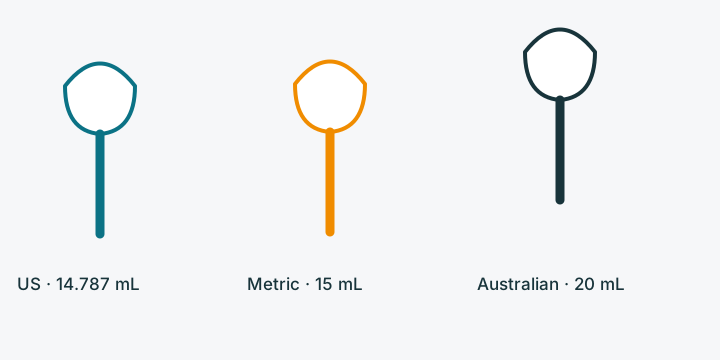
Check the spoon size before doubling a recipe: a tablespoon can mean 15 mL, 20 mL or about 14.787 mL in the US system. I keep that definition with every converted ingredient.
Read the recipe's measuring system
The language of a recipe does not uniquely identify its measuring cup. An English recipe may use US customary measures or metric measures, and a translated recipe may retain the original units. Look for a note specifying cup volume, spoon size or weights. If the author supplies grams alongside cups, I choose the grams rather than trying to reconstruct the author's cup-filling method from a general chart.
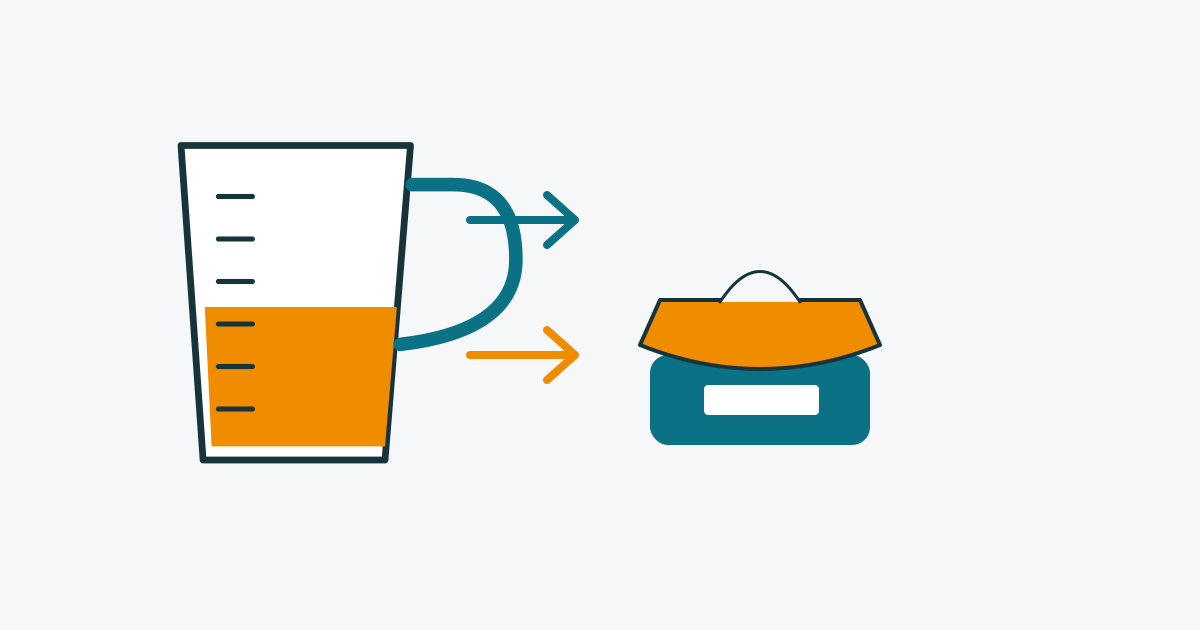
A household mug and an eating spoon are not reliable substitutes for defined measuring tools. A cup label in the converter names a particular volume, not whatever fits in your favourite cup. The goal is to match the recipe's convention, then use a measuring vessel or scale suited to that quantity. The browser drawing helps explain the relationship but cannot calibrate your kitchen equipment.
The definitions used here
The ingredient converter labels its volumes explicitly. The US cup is 236.5882365 mL; its tablespoon is one sixteenth of that cup and its teaspoon one forty-eighth. The metric cup option is 250 mL. The metric tablespoon is 15 mL and teaspoon 5 mL. The Australian tablespoon option is 20 mL. These choices are separate because replacing the names with a single “cup” or “spoon” would hide the decision that matters.
| Selected system | Cup | Tablespoon | Teaspoon |
|---|---|---|---|
| US customary | 236.5882365 mL | 14.78676478125 mL | 4.92892159375 mL |
| Metric options | 250 mL | 15 mL | 5 mL |
| Australian tablespoon option | Select cup separately | 20 mL | Select teaspoon separately |
The last row deliberately does not impose a whole recipe system. The controls let you choose the explicit unit for each ingredient. A recipe can contain a cup quantity on one line and a tablespoon quantity on another, and you should match both labels. If the recipe gives its own nonstandard volume, convert that volume through millilitres rather than treating the nearest named measure as an exact equivalent.
A spoon change follows through to mass
Honey provides a clear example because its ingredient reference is 21 g per US tablespoon in the King Arthur Baking chart. Two US tablespoons therefore give 2 × 21 = 42 g as the chart estimate. One Australian tablespoon is 20 mL, so its estimate is 20 × (21 ÷ 14.78676478125) ≈ 28.4037791 g. Selecting a different spoon changes volume before the density relationship is applied.
Do not apply that honey result to flour or butter. The spoon defines volume; the ingredient defines the estimated mass within it. A US tablespoon of butter follows the chart's 113 g per eight tablespoons, giving 113 ÷ 8 = 14.125 g. The volume definition is the same as the honey example, but the density reference differs. This is why a spoon-to-grams answer needs the ingredient's name.
Some conversions need no food choice
A cup-to-millilitre conversion stays entirely within volume. One metric cup is 250 mL regardless of whether it contains water, flour or air. In the ingredient converter, changing the selected food does not alter a volume-to-volume conversion. Likewise, mass-to-mass conversion uses the unit definitions: one pound is 453.59237 g, and one ounce of mass is one sixteenth of that pound. Fluid ounces belong to volume and must not be substituted for ounces of mass.
The general converter keeps US and imperial gallons separate. One US gallon is 3.785411784 L; an imperial gallon is 4.54609 L. The difference is too large to hide behind a label that simply says “gallon”. The NIST conversion-factor reference provides the wider context for these relationships. When copying a result, include the system in the unit name if the recipient might interpret it differently.
A practical order for adapting a recipe
- Read the full ingredient list and the author's notes before converting individual lines.
- Identify the cup and spoon volumes, and keep them separate from ingredient preparation.
- Use supplied gram weights directly; otherwise choose the closest matching published ingredient reference.
- Convert each line, inspect its source unit, and only then apply the recipe multiplier.
- Keep oven temperature, pan dimensions and cooking method as separate questions.
Imagine a recipe with 1 metric cup of flour and 2 US tablespoons of honey. Flour uses 250 × (120 ÷ 236.5882365) ≈ 126.8025851 g, while honey uses 2 × 21 = 42 g. A multiplier of two gives approximately 253.6051703 g flour and 84 g honey. The mixed source labels remain attached to their rows; no single global cup setting silently rewrites both ingredients.
These precise intermediate numbers are useful for checking the method, but a practical kitchen result should reflect the scale and ingredients. I would not claim that a flour cup was measured to a tenth of a milligram because a calculator displayed several decimal places. Round for use only after checking the definitions. Keep the unrounded calculation for a later conversion or swap.
An oven setting is another kind of conversion
Temperature is not a volume ratio. In the general converter, Celsius becomes Fahrenheit using F = C × 9/5 + 32. A setting of 180 °C gives 180 × 9/5 + 32 = 356 °F. That is the mathematical scale conversion, not a claim that an oven dial has a 356 °F mark or that two ovens heat food identically. Follow the recipe's instructions for fan settings and equipment rather than deriving a cooking adjustment from the unit formula alone.
Kelvin and Rankine represent absolute-temperature scales, so values below absolute zero are rejected. For a measured temperature, accuracy depends on the thermometer and how you use it.
Small input habits prevent large mistakes
Fractions can stay as fractions in the amount field: 3/4 and 1 1/2 are supported. A decimal comma is accepted when it is not mixed with a decimal point. Thousands separators are not allowed, so write 1000 without grouping. A mistyped suffix such as 12tbsp is rejected; put the amount in its field and choose the tablespoon in the unit control. This makes the recipe row explicit and easier to review.
Before export, inspect every filled row for the ingredient and source measure. The worksheet blocks export while an amount is invalid, and the multiplier must be between 0.01 and 100. It scales ingredient quantities only. A larger batch may need a different pan or method; doubling the numbers does not explain those changes. Return to the unit converter or read the ingredient density guide when the unit choice is settled but the mass estimate still needs explanation.
Things people ask
Is a metric cup the same as a US cup?
No. The metric option here is 250 mL; the US customary cup is 236.5882365 mL. Choose the definition specified in the recipe.
How many millilitres are in a tablespoon?
The US customary tablespoon is about 14.787 mL. The metric option is 15 mL and the Australian option is 20 mL. The name alone does not identify the volume.
Is an ounce the same as a fluid ounce?
No. An ounce of mass is 28.349523125 g; a US fluid ounce is 29.5735295625 mL. Converting between them requires an ingredient density.
Does doubling a recipe double its oven temperature?
No. The worksheet multiplier affects ingredient masses only. Oven settings, pan size and cooking method are separate decisions.